Written by Aaisha, B.Sc. Biotech, M.Sc. Chemistry
Table of Contents
Your tarantula hasn’t eaten for weeks. Its abdomen looks darker, and one morning you find it lying on its back. That sight can be alarming, but it’s usually a good sign; your tarantula is molting. Most molts go well, and a few simple habits can help your spider through the process.
What Is Tarantula Molting and Why Does It Happen?
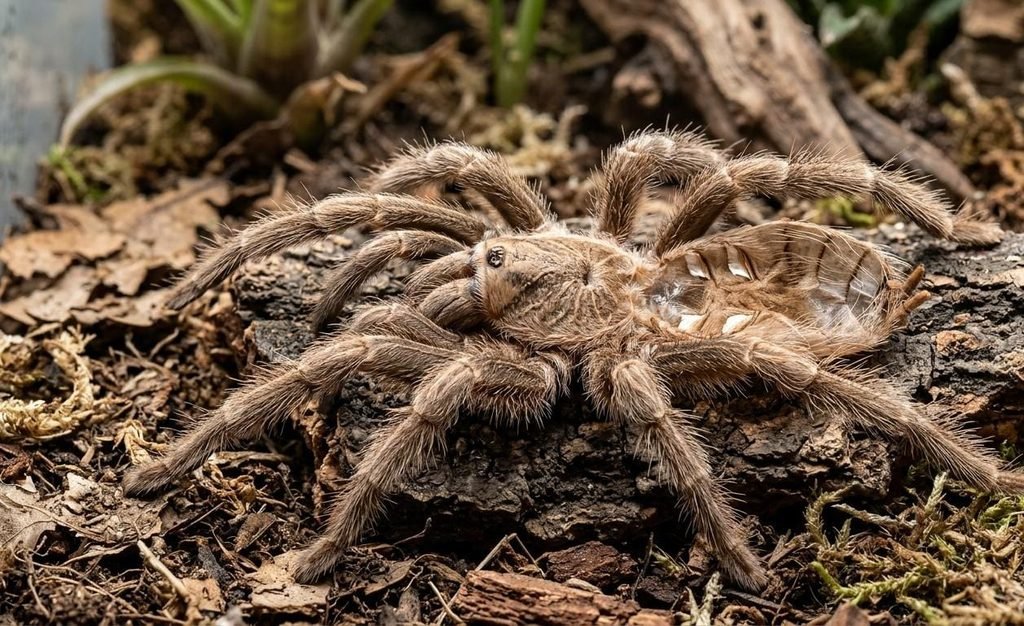
Tarantula molting, or ecdysis, is when the spider sheds its old exoskeleton to grow. The exoskeleton is like armor that doesn’t expand as the spider grows, so your tarantula needs to shed it and form a bigger one as it gets larger.
The new exoskeleton covers the legs, body, and outer mouthparts, which makes the process both impressive and challenging.
Molting also lets a tarantula regrow lost limbs. If a leg is missing, it can regrow over several moults, starting smaller and improving with each one.
How Often Does Tarantula Molting Happen?
How often a tarantula molts depends on its age, species, sex, and living conditions.
- Spiderlings grow quickly and can molt every few weeks.
- Adult females usually molt once a year or less. Many keep molting after they mature, but not as often.
- Mature males typically stop molting after their last molt and often die not long after.
If you’re not sure when your spider will molt again, try keeping a simple log of molt dates. After a few molts, you’ll get a sense of its pattern.
5 Signs Your Tarantula Molting Is Coming
Most spiders show signs a few days to a couple of weeks before molting. Look out for these five clues:
- Food refusal
If your spider suddenly ignores its food, it’s often getting ready to molt, since it stops eating before the process.
- A dull or darker abdomen
Colors may look faded as the new exoskeleton forms underneath.
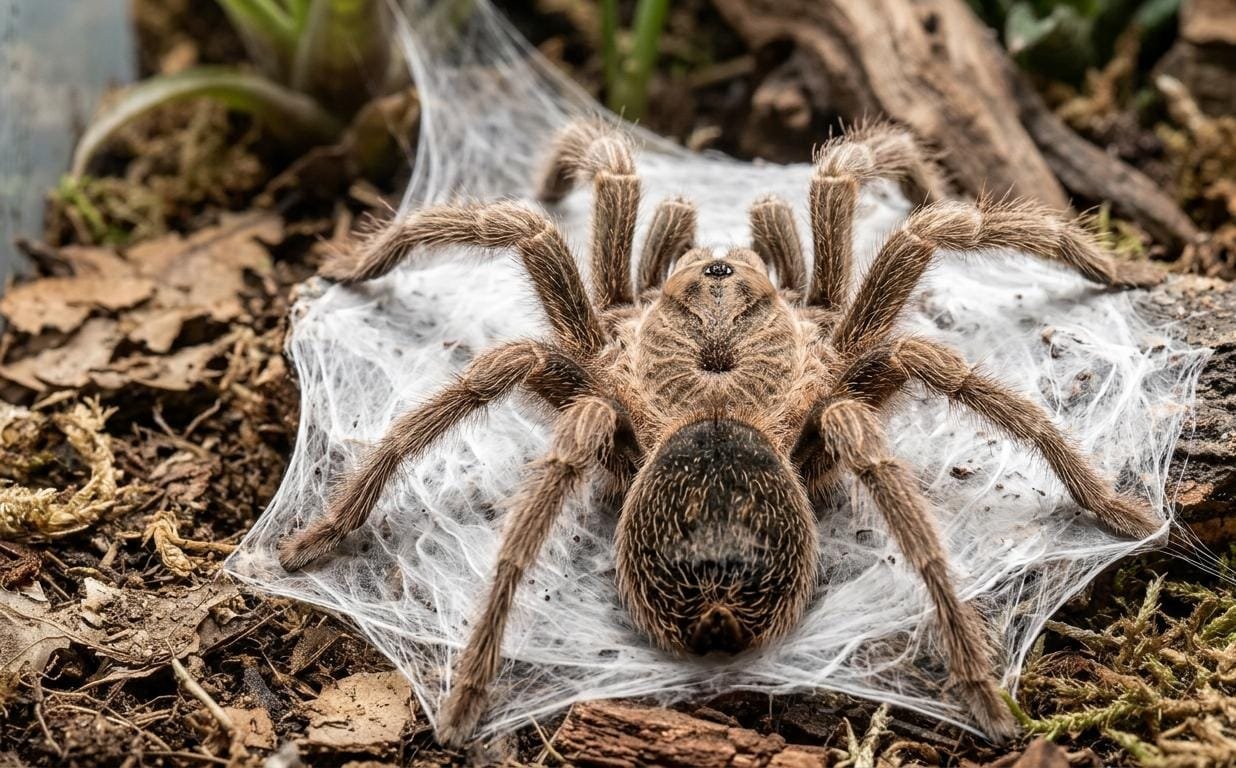
- A sheet of silk
Many species lay a flat layer of silk on the floor or wall to create a clean spot to molt.
- Extra hiding
Burrowing species might hide away for days or even weeks.
- The flip
When your spider lies still on its back in its silk, it has started moulting.
If you notice several of these signs at once, your tarantula is likely about to molt. Stop offering food and give your spider space.
Tarantula Molting Process Explained
The molting cycle begins when hormones tell the skin to separate from the old exoskeleton and start building a new one underneath. The skin pulls away from the old shell, letting the new exoskeleton form. This step is called apolysis.
When it’s time, the spider takes in fluid, increasing internal pressure and splitting the old exoskeleton along its seams. This pressure, not muscle movement, does the work.
The new exoskeleton is soft and pale at first. It’s mostly made of chitin fibers in protein, and it hardens and darkens over the next few hours or days.
Many people are surprised to learn that molting is a whole-body process. The linings of the book lungs, foregut, and hindgut also shed along with the exoskeleton.
Tarantula Molting Steps: What Happens on Molt Day
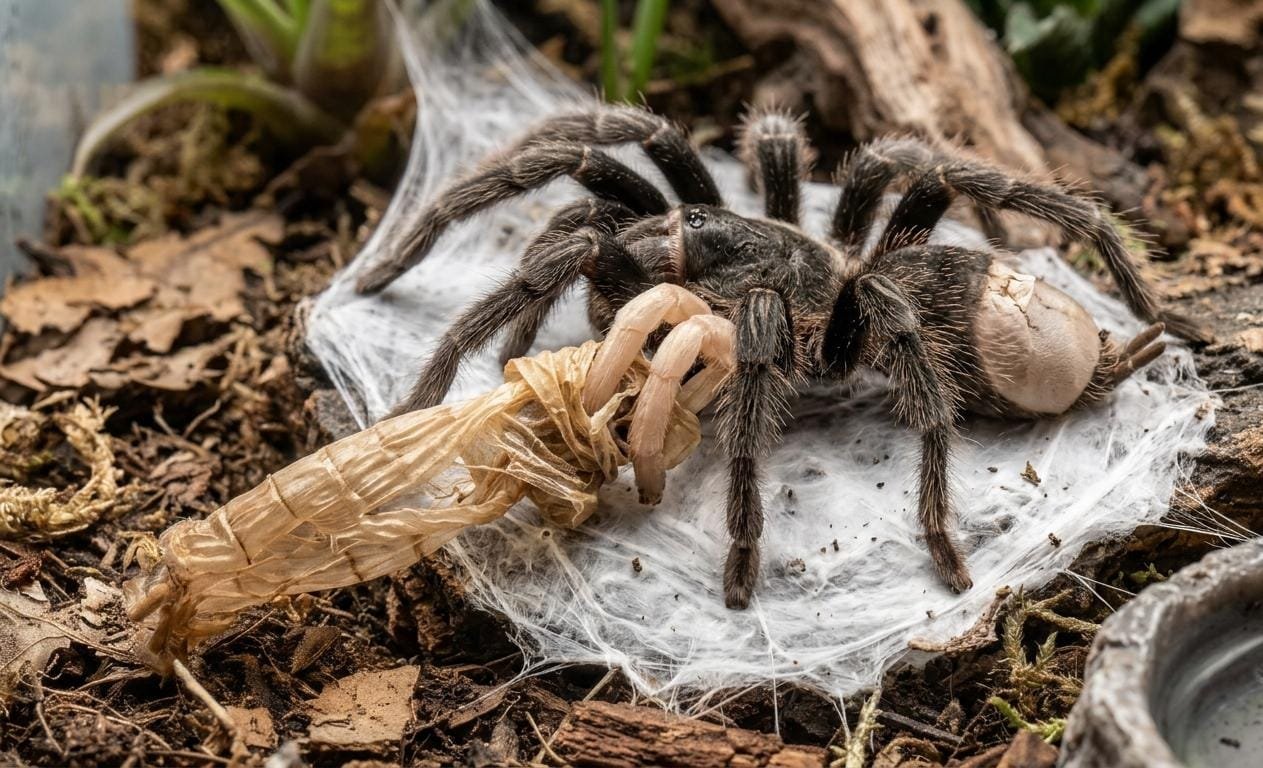
After the old exoskeleton splits, the spider works its way out. It opens at the front of the carapace, pulls its legs free, and then withdraws its abdomen.
Depending on the species and size, this can take a few minutes to over an hour. Some spiders need extra time to free their last legs.
The empty shell left behind is called the exuvia. It often looks so complete that you can see the outline of the legs and body. At this point, the spider has a soft new exoskeleton and is at its most vulnerable.
Tarantula Molting Care: Do’s and Don’ts
Caring for your spider during moulting is easier than you might expect.
Do’s:
- Take out any uneaten prey within a few hours, because a live cricket can hurt a molting spider.
- Always have a shallow water dish available, and make sure your spider can reach it easily.
- Keep the enclosure stable, and avoid adding new substrate or making big changes right before molting.
Don’t:
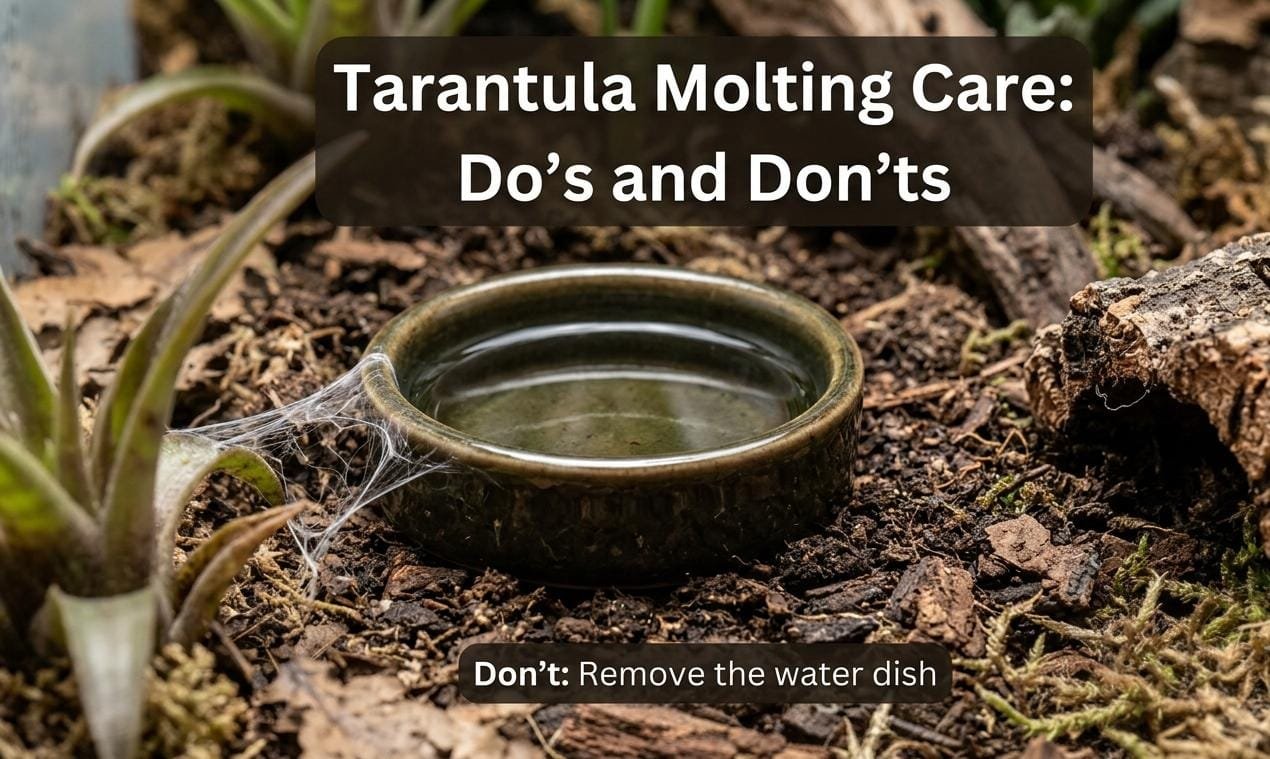
- Don’t add too much water to the enclosure. Extra humidity won’t speed up your tarantula’s molt and can cause mould.
- Don’t open the enclosure, mist, or poke your spider to see if it’s alive. If it’s lying still in its silk, it’s behaving as it should.
After your spider moves away from its old skin, you can leave the exuvia in the enclosure for a bit. Some keepers remove it right away, but there’s no hurry.
Tarantula Molting Recovery: When to Feed?
After molting, your tarantula is very fragile because its new exoskeleton needs time to harden and its fangs are still soft. Don’t touch it or try to feed it too soon.
Waiting can be tough, but feeding too soon can leave your spider vulnerable. Just provide a water dish while it recovers. You don’t need to increase humidity for the new skin to harden. When your spider moves normally and its new skin looks dark and firm, it’s ready to eat.
Juvenile tarantulas may need a few days before they’re ready to eat, while adults might need a week or longer.
6 Common Problems During Tarantula Molting
Molting is a natural process, but it’s not always simple. The tarantula must shed its entire outer skeleton, including the coverings on its long legs and mouthparts, while its new exoskeleton is still soft.
This can lead to complications. Here are the most common molting problems, what causes them, and what you can do if they happen.
- A Tarantula Gets Stuck in Its Old Exoskeleton
One of the most worrying molting problems is when a tarantula can’t fully free itself from its old exoskeleton.
The spider might only get partway out, with one or more legs, part of the abdomen, or another body part still stuck in the old skin. Sometimes the old exoskeleton stays attached even after the spider has made significant progress.
What should you do?
- Don’t try to pull off the old exoskeleton, tug on a trapped leg, or peel the skin from the spider. The new limbs are soft, and forcing them can cause serious harm.
- If the spider is clearly stuck or getting worse, get advice quickly from a vet experienced with exotic invertebrates.
- A Tarantula Loses a Leg During Molting
A tarantula can lose a leg during a tough moult, especially if a leg gets stuck in the old exoskeleton or the spider injures it while trying to free itself.
But a missing leg isn’t always caused by molting.
Spiders can also lose legs through autotomy, when they shed a limb on purpose as a defence. Injuries and other situations can also cause leg loss.
What should you do?
- Let the tarantula molt and recover without disturbance. Don’t handle it to check the missing leg.
- Watch to see if the spider can move normally once its new exoskeleton has hardened. If bleeding continues, the wound stays open, the spider seems weak, or you notice other serious injuries, contact a vet.
- The Tarantula Has Trouble Hardening
Just because the tarantula has finished molting doesn’t mean its new exoskeleton is ready for normal activity right away.
The new cuticle is soft at first and slowly hardens as its structure and chemistry change. This is important because the exoskeleton gives support and protection, and the fangs need to harden before the spider can catch prey.
What should you do?
Give your tarantula plenty of time to recover. Don’t handle it, disturb the enclosure, or feed it too soon.
Don’t try to speed up hardening by using supplements, oils, or other products on the exoskeleton.
Wait until your spider has recovered and its fangs are hard before offering food. The right waiting time can vary, so don’t assume every tarantula is ready to eat after a set number of days.
If the new exoskeleton still looks abnormal or your spider shows other worrying signs, consult a specialist.
- A Tarantula Appears Weak or Exhausted After Molting
A tarantula might stay still for a long time after shedding its old exoskeleton. It may not walk around, explore, or show interest in food right away.
This is normal because molting is hard work, and the spider needs time for its new skin to mature. The fangs and other parts also need to harden before it can eat safely again.
Inactivity alone isn’t a problem. It’s only a concern if it’s accompanied by signs of injury, a failed moult, or other health issues.
What should you do?
Look at the whole situation:
- Has the spider successfully emerged from the old exoskeleton?
- Are any body parts still trapped?
- Is there visible damage?
- Does the spider appear to be recovering, even if it remains inactive?
- Are there other concerning signs beyond simply refusing food?
No single healing timeline fits every species or size.
A small juvenile might recover faster than a large adult, and each spider’s situation is different.
- The Tarantula Dies During or Shortly After Molting
This is what every keeper hopes won’t happen.
Sadly, some tarantulas die during molting or soon after. The process is physically demanding, and complications can become serious.
But don’t assume every death during molting is caused by the molt itself.
Illness, injury, dehydration, or environmental issues can also play a role. Sometimes you can’t tell the exact cause just by looking.
What should you do?
- If your tarantula looks dead, don’t remove it or throw away the exuvia right away. Take time to assess the situation first.
- If you suspect a death related to molting, check the enclosure conditions, hydration, feeding history, and any signs of illness or injury. This can help you spot husbandry issues to fix before the next molt.
- A Tarantula Appears to Have an Incomplete or Abnormal Molt
A strange-looking exuvia can make you worry that something went wrong.
The shed exoskeleton might be folded, torn, or incomplete. Sometimes, parts of it stay attached to the spider.
Not every odd-looking shed means the molt failed. The exuvia can get distorted as the spider moves, and its appearance alone doesn’t always show what happened during molting.
What matters most is whether your tarantula has emerged successfully and whether any body parts are still trapped.
What should you do?
- Don’t disturb your spider just because it’s stayed in one spot for a long time. Check the situation carefully without handling or moving the animal.
- If your spider is clearly trapped or injured, get advice from a specialist right away. One incident may not show the cause, so don’t jump to conclusions without enough evidence.
Can You Prevent Molting Problems?
You can’t prevent every problem, but good husbandry can lower the risks you can control.
- Start by providing the conditions your tarantula’s species needs. Temperature, humidity, ventilation, substrate, and hydration should match its natural environment, not just a standard set of numbers.
- Give your spider enough space and a good surface to molt without obstacles. Don’t disturb the enclosure when you see premolt signs, and remove uneaten prey instead of leaving feeder insects with a vulnerable spider.
- Nutrition and hydration matter for your tarantula’s health, but no feeding schedule or humidity level can guarantee a perfect molt.
- Most importantly, remember that premolt, molting, and recovery are separate phases. A tarantula that’s shed its old exoskeleton still needs time to recover.
When Should You Intervene During a Tarantula Molt?
It can be upsetting to watch a tarantula struggle to shed its old exoskeleton. Wanting to help is natural, but handling a spider during molting can do more harm than good.
In most cases, leave the tarantula alone when:
- It is lying on its back but appears to be progressing through a normal molt.
- It pauses between movements.
- Its legs look awkwardly positioned but are not visibly trapped.
- It has completed ecdysis and is resting while its new exoskeleton matures.
Seek prompt specialist advice when:
- A leg or another body part is clearly trapped in the old exoskeleton.
- The spider cannot complete ecdysis.
- There is significant visible injury.
- The spider’s condition is deteriorating, or other signs indicate a serious problem.
Don’t pull at the exuvia, force a trapped leg free, or put water directly on the spider to loosen the old skin.
If a real complication happens, the safest response depends on the situation. An experienced exotic-invertebrate vet can help you decide if intervention is needed.
When to Call a Vet
Many keepers cannot find a vet within a reasonable drive who treats exotic invertebrates. If that is you, the good news is that most molts go fine with hands-off care. Still, call a vet or experienced specialist if a leg or body part is clearly trapped, the spider cannot finish the molt, there is significant visible injury, or it is getting worse over several days.
If you cannot reach a vet, a specialist keeper group or online community can sometimes help you think through the situation, though they cannot replace an exam.
Frequently Asked Questions
- How long does tarantula molting take?
Active shedding usually takes anywhere from a few minutes to a few hours, but a tough molt can last longer. The whole process, including preparation and recovery, takes much longer.
- Why does my tarantula lie on its back during molting?
This common molting position helps the spider work its body and legs out of the old shell. If your spider shows other molting signs, just leave it alone.
- Can a tarantula regrow a lost leg?
In many cases, yes. A lost leg can grow back over several molts, though the new leg usually starts smaller and gets better with each molt.
- Why hasn’t my tarantula eaten after molting?
Your spider might still be recovering, and its fangs may not be hard enough to eat yet. Give it some time. If it still won’t eat long after what’s normal for your spider, check with an experienced exotic-animal vet.