Written by Aaisha Naaz (B.Sc. Biotech, M.Sc. Organic Chemistry)
Table of Contents
So, you’ve just set up your tarantula’s enclosure, including a water dish, and you’re already second-guessing which hydration methods to use. Should you be misting too? Is the dish even necessary? Every keeper seems to have a different answer to the tarantula water dish vs misting debate, each one delivered like it’s the only correct way to keep a spider alive.
Here’s the thing nobody tells beginners: there isn’t one right answer.
Some keepers swear by a water dish and think misting invites mould. Others mist religiously and worry a dish will drown a young spider. And then there’s a third group, the ones who haven’t offered direct water in years, and their tarantula is somehow still thriving, plump, and enormous.
All three of them are right. Not because tarantula care is a free-for-all, but because the “correct” method depends entirely on your spider’s species, its enclosure, and its age.
So instead of picking a side in this tarantula water dish vs misting debate, let’s break down when each method works, when it backfires, and how to tell, just by looking at your spider, whether what you’re doing is working.
Why Tarantula Hydration Advice Is So Confusing
Tarantulas get moisture two ways: they drink from a water source, or they absorb ambient humidity from their environment and food. Different species rely on these sources to very different degrees, which is why one method works great for one keeper’s collection and flops for someone else’s.
Tarantula Water Dish vs Misting: 3 Common Hydration Methods
Before we go deep on each one, here’s the short version: a water dish, misting, and offering no direct water source at all can all be correct. But the right pick depends entirely on species and life stage. Here’s a detailed comparison of three different tarantula hydration methods:
1. Tarantula Water Dish: The Simple Hydration Solution
A water dish is probably the easiest way to give a tarantula access to clean drinking water. It is the simplest approach because the tarantula decides when it wants to drink. And you don’t have to guess; you just provide it.
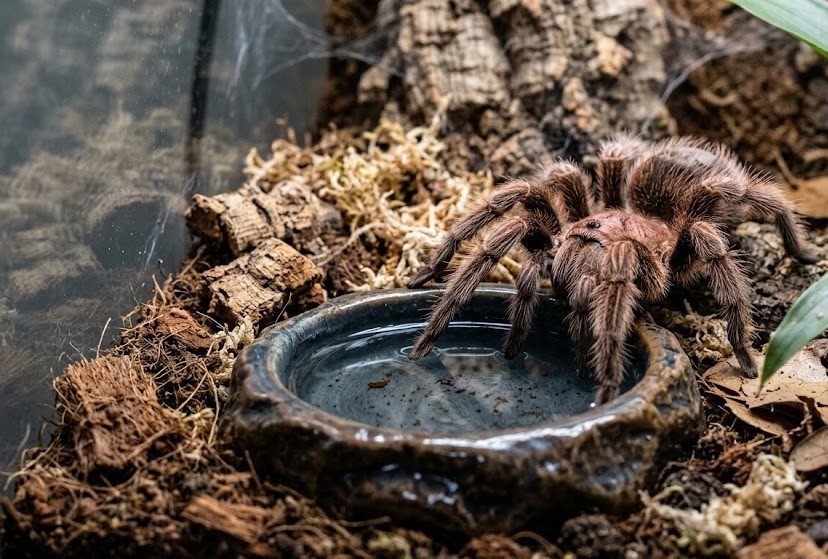
Why water dishes work:
A clean dish provides a consistent water source, so you don’t need to rely on repeated misting or perfect humidity across the enclosure.
Do All Tarantulas Need a Water Dish?
Yes, for many commonly kept species, especially juveniles and adults. But the setup depends on species and enclosure size. For example:
- Tiny tarantula slings usually can’t use a conventional dish safely; a damp substrate patch or a carefully managed moisture source works better.
- For larger terrestrial tarantulas, a shallow dish is usually best.
- Arboreal species are a bit different since they spend most of their time off the ground, but they should still have access to water.
How to Use a Tarantula Water Dish Properly
- Use clean water, a clean dish, and refill regularly.
- Your water dish doesn’t need to be fancy; a shallow container the tarantula can easily reach is enough.
- Clean the dish regularly, remove debris, and change the water when it gets dirty.
Don’t panic if you never actually see your tarantula drinking from it because tarantulas don’t keep a visible drinking schedule. Also, you’re not watching the enclosure 24 hours a day.
2. Misting a Tarantula Enclosure: Useful or Unnecessary?
Misting is common, and also one of the most misunderstood hydration methods.
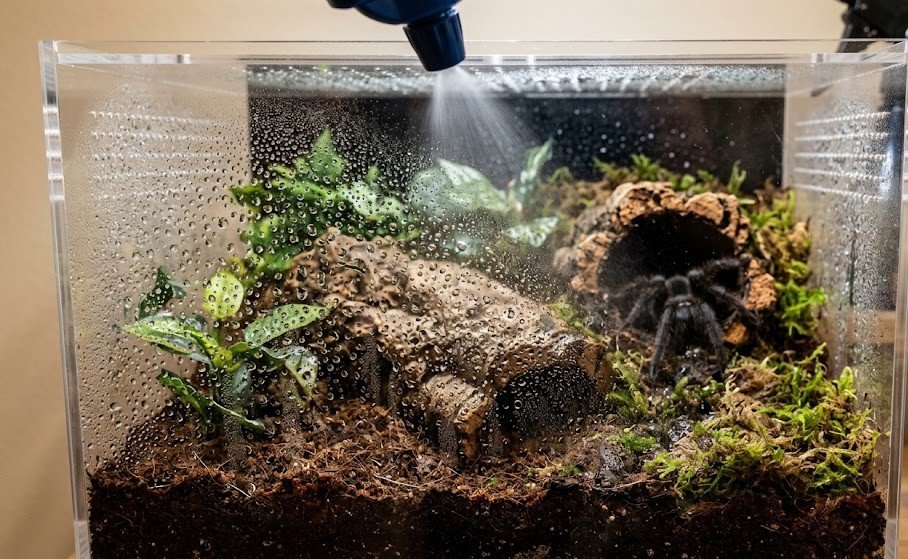
When you spray an enclosure, you’re not creating permanent humidity; you’re temporarily adding moisture. Some of the moisture evaporates, some lands on the substrate or enclosure surfaces, and some stays as droplets.
In a well-ventilated enclosure, moisture can disappear fairly fast. So, spraying once doesn’t match the steady access a water dish provides.
What misting is actually doing to your tarantula enclosure:
- Quickly bumps humidity for species that don’t use water dishes, or in setups where a dish isn’t practical
- Suits arboreal species, most of which rarely touch standing water
- Helps during premolt, when moisture needs often go up
- Lets you raise humidity without soaking the whole substrate
The Problems With Routine Misting
The mistake is assuming more moisture automatically means better hydration. It isn’t, instead it is harmful for your tarantula enclosure:
- Repeatedly soaking the enclosure leaves the substrate permanently wet. And if there’s poor ventilation, it can invite mold and bacteria.
- Moreover, a constantly wet enclosure isn’t just a wetter version of a dry setup; it’s a different risk entirely, as frequent spraying can also unnecessarily stress the tarantula.
3. Can Your Tarantulas Live Without a Water Dish Or Misting? (The Case for Neither)
This might sound risky at first, but it depends entirely on the species. Many arid, fast-growing ground species get enough water from their food, especially as adults. Some keepers never use dishes or misting and still have healthy spiders.
But this only works when:
- The species is genuinely arid-adapted, not just labelled “hardy” online.
- You feed live, fresh prey consistently, so it actually contributes moisture.
- You’re watching the spider’s condition closely rather than assuming it’s fine.
The Overhydration Risk Nobody Talks About
Most online advice focuses on preventing dehydration, but adding too much water can be just as problematic. Here’s what happens if you provide a constantly wet substrate, an overflowing dish, or misting on a fixed schedule regardless of conditions:
- Waterlogged substrate breeds mold and grain mites, and can trigger fungal infections in species built for dry, well-draining soil.
- Constant high humidity restricts airflow through the book lungs, which can stress a species that isn’t adapted to it.
- Overly damp conditions attract pest insects that harass the tarantula, especially slings.
Therefore, let the substrate dry out between waterings unless your species needs constant dampness, and mist only as needed.
Can a Dry Tarantula Enclosure Still Be Hydrated?
Some keepers run very dry setups, especially for arid-adapted species, and that’s not automatically a problem. But there’s an important distinction: dry doesn’t mean dehydrated.
A tarantula can live in a dry enclosure and still have full access to drinking water. This is where a water dish earns its keep; instead of humidifying the whole enclosure, it provides a reliable water source while keeping everything else appropriately dry.
Matching Hydration Method to Tarantula Species
As already mentioned above, no universal tarantula hydration recipe exists. However, you can’t keep a species from relatively dry conditions, like a rainforest species. Similarly, you can’t keep a moisture-loving tropical species bone-dry just because another keeper does it that way. For instance:
- Grammostola pulchripes and other grassland terrestrials do best with a water dish once they’re large enough, minimal misting, and a mostly dry substrate with maybe one damp corner.
- Avicularia species and other arboreal tarantulas rarely touch a dish, relying almost entirely on misted enclosure walls and humidity from a ventilated cork bark setup.
- Aphonopelma and other North American desert species can go long stretches with minimal intervention once established, as long as they’re fed live prey regularly.
- Theraphosa and other humid rainforest species need consistently damp substrate and higher ambient humidity. These species are one of the few cases where “keep it moist” is genuinely the correct default, not the exception.
So, use the general category as a starting point, but tailor your setup to the specific species, and let the spider’s condition guide whether it’s working.
Tarantula Hydration vs Humidity: What’s the Difference?
Now that you’ve seen all three methods ( tarantula water dish vs misting and no water at all), it’s worth separating two words people use interchangeably: hydration and humidity.
- Hydration is about the tarantula having access to water.
- Humidity is the moisture level in the surrounding air.
A tarantula can live in a relatively dry enclosure and still have full access to drinking water. Or an enclosure can be extremely humid and still poorly managed, with stagnant air and constantly soggy substrate.
So, you dont have to chase a single humidity number. Whichever of the three methods mentioned above fits your species, focus on the conditions it’s adapted to, and make sure water is available when it’s needed.
Quick Tarantula Hydration Guide (Cheat Sheet)
Instead of debating tarantula water dish vs misting in the abstract, lets break it down by category:
| Category | Approach |
| Adult terrestrial species | Water dish, refreshed regularly |
| Arboreal species | Light misting on enclosure walls |
| Slings and small juveniles | Water droplets or a damp substrate patch, not a dish |
| Arid, fast-growing species | Minimal intervention, monitored closely |
| Any species in pre-molt | Slightly higher humidity, regardless of usual method |
This is a general guide, not a substitute for species-specific care information.
7 Signs Your Tarantula Needs More Water (Dehydration Symptoms)
One of the biggest mistakes in tarantula keeping is diagnosing everything from a single behavior. A tarantula sitting still for hours doesn’t automatically mean dehydration, and hiding doesn’t automatically mean something’s wrong.
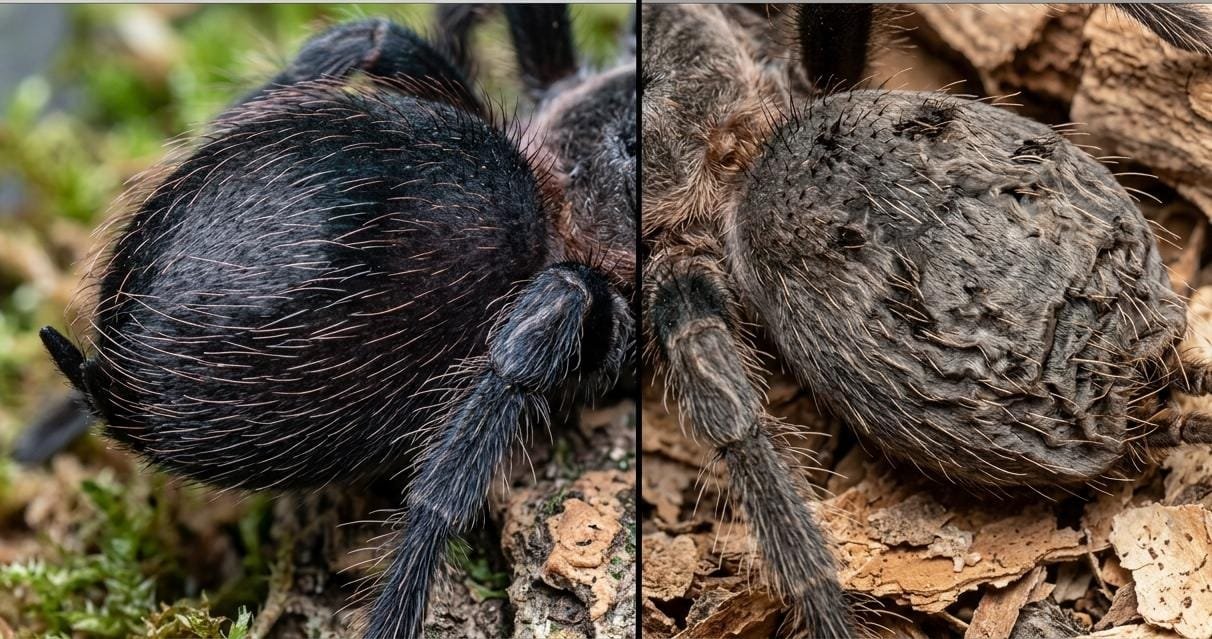
Look for these seven signs together, not in isolation:
- Wrinkled or shriveled abdomen
A hydrated abdomen looks smooth and slightly rounded; a dehydrated one looks visibly deflated or pruned.
- Reduced appetite over several feedings
If your tarantula is occasionally refusing food, it’s normal, especially pre-molt, but a consistent drop paired with other signs is worth noting.
- Dry or flaky appearance
The abdomen or legs look unusually dull or dry rather than their normal slight sheen.
- Unusual Lethargy
Tarantulas are naturally still animals, but unusual weakness or a lack of response to gentle stimulation is a warning.
- Legs curling inward
A curled, cramped leg posture (rather than the normal relaxed sprawl) can also signal significant dehydration or distress.
- No response to a water source once provided
If a newly added dish or misting gets an unusually strong reaction (rushing to drink), that itself confirms the spider was under-hydrated.
- Sunken abdomen
In more advanced dehydration, the abdomen can look noticeably smaller than usual relative to the carapace.
Hence, whichever side of the tarantula water dish vs misting debate you’re on, dehydration signs look the same either way.
5 Signs of Tarantula Overhydration (Too Much Moisture)
- Permanently soggy or waterlogged substrate that never dries out between waterings
- Mold or fungal growth on substrate, decor, or enclosure walls
- Persistent condensation on the enclosure glass or lid
- Unpleasant, musty smell coming from the enclosure
- 5. Rising numbers of fungus gnats or mites
A little moisture isn’t dangerous, but constant, uncontrolled moisture combined with poor airflow is. Your healthy tarantula enclosure shouldn’t look like a miniature swamp. This is the flip side of the tarantula water dish vs misting debate; too much of either method causes its own problems.
How to Tell If Your Tarantula Hydration Method Is Working (Abdomen Check)
Forget the method for a second and look at your spider’s abdomen. It’s soft, not armoured like the carapace, and its size shifts with hydration:
- Plump and rounded means well-hydrated.
- Wrinkled, shriveled, or sunken means it needs more water.
This one check matters more than any tarantula water dish vs misting debate, because it tells you what’s working for your individual tarantula.
6 Common Tarantula Hydration Mistakes to Avoid
- Misting every day because the enclosure looks dry.
A dry-looking enclosure isn’t automatically a problem; instead, check the species’ requirements before reaching for the spray bottle.
- Keeping the substrate permanently soaked.
More moisture isn’t always better, and constantly wet substrate causes problems fast, especially with poor ventilation.
- Removing the water dish because the tarantula never drinks from it.
Not seeing it happen doesn’t mean it doesn’t happen. If the dish fits and stays clean, you shouldn’t pull a useful water source.
- Obsessing over a single humidity number.
A hygrometer is useful information, not the whole picture; species, ventilation, substrate, and the animal’s actual condition all matter more.
- Copying another keeper’s setup exactly.
What works for their tarantula, room, and climate won’t necessarily work for yours, even with the same species. So look for what works best for your tarantula.
- Disturbing the tarantula too often.
Repeatedly opening the enclosure, spraying around it, or checking whether it’s drunk yet is usually more intervention than your tarantula needs.
5 Mistakes that show up regardless of method:
- Using a water dish so deep a sling or small juvenile could drown in it
- Misting directly onto the tarantula instead of the enclosure surfaces
- Assuming “arid species” means “never needs monitoring”
- Letting a water dish sit unchanged for weeks, growing bacteria or mold
- Switching methods every time you get nervous instead of watching the abdomen over time
Ending the tarantula hydration debate
There’s no winner of this tarantula water dish vs misting and no water at all debate. That’s because a water dish isn’t better than misting; misting isn’t wrong either, and a dry enclosure isn’t dangerous. At the end of the day, the tarantula water dish vs misting debate isn’t about picking a winner; it’s about matching the hydration method to your spider.
The only real mistake is treating any single method as a universal rule. What actually matters is your tarantula species, its life stage, ventilation, and actual enclosure conditions. Match those, watch the abdomen, and the “debate” pretty much solves itself.
Frequently Asked Questions
Do I need to provide a water dish for all tarantulas?
This is really the heart of the tarantula water dish vs misting debate, and the honest answer is: it depends on the species. Many species do fine without one, especially tarantula slings, arboreal species, and arid-adapted adults. Make sure they meet their hydration needs another way, and they’ll thrive.
How often should I mist my tarantula’s enclosure?
Misting depends on the species and current humidity. However, a light misting every few days is a reasonable starting point for humidity-loving species. Then adjust your misting schedule based on how quickly the enclosure dries out.
What does a dehydrated tarantula look like?
A shrivelled or wrinkled abdomen is the clearest sign. A healthy, hydrated abdomen looks smooth and slightly rounded.
Can I switch methods partway through a tarantula’s life?
Yes, you may switch and many keepers do so. You can add a water dish once a sling gets big enough to use one safely, even if droplets or misting worked earlier.
Can a tarantula get too much water?
Yes. Waterlogged substrate and consistently high humidity can cause mould, mites, and fungal issues, and can restrict airflow to the book lung. More water isn’t automatically safer than less.
Does tap water need to be treated before use?
Dechlorinated water is the safer default, since tap water in many areas contains chlorine or chloramine. Let it sit out for 24 hours, or use a reptile-safe water conditioner, before it goes in a dish or mister.